Showing posts with label creme caramel. Show all posts

Saturday, 25 June 2011

Pt 3.....Dessert

Lets get this straight right from the start I'm not a dessert man but I'm starting to get my head around a few classic concepts that may very well spark my dormant passion for the sweet stuff.

The urge to make a crème caramel came after a request from my expectant partner for something with custard.

Well if I don't understand the excitement some people get from the thought of a sweet dessert I do understand cravings.....I have them all the time, usually not all that gastronomic either! Quite the opposite.


A classic dessert such as crème caramel needs a classic recipe so out came Larousse Gastronomique. I'm certainly not going to take any credit for coming up with this all by myself although I did add a sliver of dark chocolate to the finished pudding as I thought the bitterness or the chocolate might be a nice contrast to the sweetness of the baked custard and caramel sauce.

There are three elements to this dessert. The custard and caramel really need to be done at the same time but the chocolate element can be done at any time. You only need to allow the custard to cool before serving as it can be served slightly warm but I like my custard cold so for me preparing a day (or few) before and leaving in the fridge overnight gives the best results.

You'll need 4 ramekins or similar oven proof moulds. The ones I used had small lips near the top which made it quite difficult to turn the finished desserts out neatly (as you may notice in the pic) so I'd recommend you use moulds without completely flush sides. Also they must be perfectly dry because any moisture will ruin the caramel.


Crème caramel with dark chocolate

Serves 4

For the caramel -

100g x Granulated Sugar
1 tsp x Lemon Juice
1 tbsp x Water


1. Put all the ingredients into a small saucepan, a heavy bottomed one works best. Heat until the sugar melts and keep heating until it turns a pale brown colour.

2. Pour a little of the melted caramel into the bottom of a mould and swirl it around until it covers the base completely. Don't be tempted to put too much in, you really only want to just coat the mould. Repeat for the remaining moulds and set aside.

(Many recipes will instruct you to coat the whole mould including the sides but I found that this just give too much caramel and makes the finished dessert far too sweet)


For the baked custard -

4 x Egg yolks
2 x Whole eggs
125g x Caster sugar
500ml x Milk
1 X Vanilla Pod


1. Preheat the oven to 185C and find an oven dish big enough to house the 4 moulds and also tall enough to be able to fill with water near enough up to the top of the moulds. This is called a "Bain marie".

2. Pour the milk into a saucepan then split the vanilla pod and scrap the seeds into the milk. Slowly bring the milk to the boil over a medium heat then remove once it has boiled.

3. While the milk is coming to the boil put the egg yolks, whole eggs and caster sugar into a mixing bowl and whisk until is all combined.

4. Next you need to slowly add the milk to the egg mixture. It's important that you whisk the mixture all the time while adding otherwise the eggs will start to cook too quickly and you'll end up with scrambled egg rather than a nice smooth custard.

5. Pour the custard into the moulds leaving a bit of a gap at the top, no less than 5mm then place the moulds into the oven dish.

6. Using a jug fill the surrounding oven dish with cold water until it comes level with the custards inside the moulds. Then being extra careful not to let the water spill over into the moulds place the bain marie into the middle of the oven.

7. Bake for around 40 minutes until the custards are just set then remove from the bain marie and allow to cool.

8. If you want to serve them warm them all you need do is run a knife carefully around the custards then turn them out. If like me you like them cold then prior to serving you'll again need to give them a quick warm up in a bain marie for about a minute or two (which you can do on the hob) so that they loosen up a little and then run a knife around and turn them out.


For the dark chocolate -
(optional)

25g x Dark chocolate
(min 70% cocoa solids)
10g x Caster sugar
10ml x Double cream


1. Heat the cream and sugar in a small saucepan over a low heat then break up the chocolate and add into the bowl stiring until is all combined and smooth.

2. Get a sheet of baking paper and pour the chocolate onto it spreading it out evenly into a thin layer then put in the fridge to cool.

3. When it comes to serving you just need to score out the shape you require and then using a thin cold knife just lift the chocolate shape off the baking paper and onto your serving dish.

I'm thinking that next time I do this I might try and cut a chocolate circle which matches the size of the turned out crème caramel !??!

So anyway that's it. My seasonal dinner party menu is complete. An easier and tastier menu I challenge you find :-)

Toodlepip xxx

Friday, 24 June 2011

Part 2 - Main Course......

Yesterday I gave you part one of the easy seasonal dinner party menu and today I give you the main course, again it's very easy to do, it takes little effort but gives a great result.


I'm using Lamb which we're told is best at this time of year but as renowned chef Paul Clerehugh will tell you however this is not necessarily true. The notion of British spring lamb is really just a bit of a marketing ploy originally intended to push the sales of New Zealand lamb in the UK because for a Lamb to be ready to eat in spring it needs to have been born in November.

Anybody with even the slightest knowledge of seasonal Britain will be all too aware that weather conditions in November really do not tend to produce the lush green fields necessary for good grazing. Around the end of March is when most lambing occurs so in fact the ideal time to really be eating British lamb is around September or October when they have had a whole summer of lush vegetation to eat rather than being bred mainly indoors and fed on protein pellets which only diminishes the flavour and texture.

Nevertheless good lamb can be found but you need to be picky. Don't go for the cheapest you see on the shelf. Look for something with pedigree and preferably organic. Better still go to your nearest specialist butcher rather than the supermarket.

My defence for calling this a seasonal dish comes from this public perception of spring lamb and because the flavour of lamb really does lend itself to a warm sunny day especially when using rack of lamb which I do in this dish.

It comprises of three elements and I'm starting with the lamb element but you could easily prepare the vegetable and broth parts in advance because they only need re-heating prior to plating up.

Like I keep stressing this whole menu requires very little cooking on the day which leaves you to be the stress free and cool as a cucumber host that makes other people jealous.

Rack of Lamb with summer vegetables and lamb broth

Serves 4

For the lamb -

2 x Rack of lamb
Unsalted butter
Olive oil
Dried thyme
Salt & Black Pepper


1. French trim the lamb (video) and cut each rack in half leaving 4 joints with equal amounts of meat, usually works out at 3 or 4 cutlets per person. Season each half rack all over with some salt and pepper.

(If you think there is too much fat on the topside of the meat then shave some off with a sharp knife. Some of the fat will render off when cooking but anything more than about 5 millimetres won't be pleasant when eating)

2. Set the oven to 140C/285F to preheat then take a frying pan and put on the hob over a medium heat. Add in a good knob of butter and a glug of olive oil and let this melt down until the butter/oil mixture starts to bubble.

3. Brown off the lamb on all sides in the butter so it they have a nice uniform colour all over then transfer to an roasting tin.

4. Before putting in the oven sprinkle over some of the dried thyme then place in the middle of the oven. It'll take around 20 minutes for the lamb to cook rare and around 25 minutes for medium which is what I would recommend. It's important to let the lamb rest for at least 5 minutes (preferrably 10) before carving into individual cutlets.


Summer Vegetables

400g x Jersey royal potatoes
300g x Asparagus
200g x Shelled fresh peas
200g x Fresh Broad Beans (skinned)
1 x Bowl of iced water


1. Wash all the vegetables under cold running water then boil the potatoes until they are tender then drain and transfer to bowl of iced water.

2. Put the peas and broad beans into a saucepan of water and bring to the boil. While they are boiling remove the woody root ends from the asparagus by holding them lightly at each end and bending them until they snap (discard the woody bits). Cut off the whole of the tips then slice the remaining stems into 1/2 inch thick pieces before adding to the pan of peas and broad beans.

3. Boil the vegetable for a further 3 minutes then drain and tip into the iced water bowl along with the potatoes. This halts the cooking process as well as keeps the brightness of colour.

As I mentioned before this can be done a few hours in advance because the final process before serving is to simply drain them off and heat them through in a frying pan over a medium heat with some butter and seasoning. (Cutting the potatoes in half before heating through is a good idea)

If you do decide to prepare them early then once they have fully cooled in the water drain them off, transfer to another bowl and toss in a little lemon juice. This will also preserve the colour of the veg.


Lamb Broth

500ml x Lamb Stock
1 x Small onion
1 x Small carrot
1 x Celery stick
1 x Clove of garlic
Fresh mint
Salt & black pepper
Olive oil


1. Heat a little olive oil in a pan over a medium heat.

2. Slice up the onion, carrot, celery and garlic and then add to the pan and allow to cook a while until the onions soften then pour in the stock and allow to simmer. There is no need to be dainty with the veg, it'll be sieved off later.

3. After a minute or two throw in around 8 or 10 chopped mint leaves. You could use dried but if you do bear in mind that dried herbs are stronger than fresh ones and for me they lack the zesty zing you get from fresh herbs.

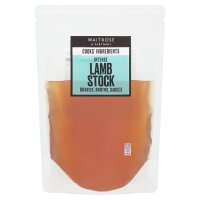
4. Keep it simmering away making sure you taste regularly and add seasoning as you go. The stock I've pictured is from the cooks ingredients range at Waitrose. You could make your own, buy one like I have mentioned or if absolutely necessary use a stock cube or two although I find these very salty and nowhere near as good as decent liquid stock.

5. Once you are happy with the taste strain the broth through a fine sieve and either leave to cool for heating up later or keep warm until you are ready to serve.

Again presentation is up to you but because the broth is involved you will need fairly high sided serving plates and large pasta bowls would work perfectly.

Just pile up some of the warmed vegetables in the centre of the then on top of these rest your carved lamb cutlets. Finally spoon over the liquid broth. Maybe sprinkle over some finely chopped mint to garnish and there you have a wonderfully light and tasty seasonal main course.

And what do we have in tomorrows blog? Dessert of course.............

Crème caramel with dark chocolate


Yes I did have a little difficulty getting them out of the moulds but because I did I can explain why you don't have too :-)

.............toodlepip xx